Difference Between Old Player Authentication and New Player Authentication
Behaviors of SetInAppUser and GetInAppUser in Client API and Player / Player Link API in RESTful API have been changed since March 15, 2017.
The change of behaviors enables the data takeover or linkage other than in the first startup, which had been limited, only if SetInAppUser and GetInAppUser in Client API and Player / Player Link API in RESTful API are used.
Also, if the takeover or linkage other than in the first startup of the application is not performed, the implementation for the change of this behavior does not have to be changed. If this takeover or linkage is performed, the function for this takeover or linkage must be implemented in addition.
Terms
| Terms | Descriptions |
|---|---|
AndApp user | Smallest unit of resources when AndApp identifies a user. The application side needs not consider anything. * For details, refer to here. |
Player | It is created automatically when an AndApp user starts a game. A new player is created per game even for the same AndApp user. * For details, refer to here. |
App user (InAppUser) | User information managed on the game side. |
Mobage linking | The AndApp client can share application data with another AndApp client by linking with Mobage ID through IdP linkage. |
Previous Player Authentication | Player authentication using Player API of RESTful API. The information of an app user should be retained on the app server. Takeover or linkage other than in the first startup is prohibited. |
New Player Authentication | Player authentication using SetInAppUser and GetInAppUser in Client API and Player / Player Link API in RESTful API. Takeover or linkage other than in the first startup is enabled. |
Ease of Restriction of Previous Player Authentication
The following restrictions are established originally:
- If the player linked with Mobage is linked with an app user (InAppUser), the app user cannot be interchanged
- If the player linked with Mobage is linked with an app user (InAppUser), the app user cannot be linked with other players
- Takeover or linkage other than in the first startup is prohibited
The reason for these restrictions is to prevent the same app user (InAppUser) connected with multiple Mobage IDs from collecting free Mobacoin.
However, the following problems may occur accordingly:
- If you start a new play by mistake in an AndApp client linked with Mobage, the app user cannot be linked again.
- Incorrect data is taken over in an AndApp client linked with Mobage.
- If you start a new play or take over incorrect data in an AndApp client not linked with Mobage, you must uninstall the AndApp client and start a new game as a new AndApp user.
In “New Player Authentication”, restrictions 1 and 3 are removed and the takeover or linkage other than in the first startup is enabled to solve these problems above. “New Player Authentication” can be used only if SetInAppUser and GetInAppUser in Client API and Player / Player Link API in RESTful API are used.
The information that an app user (InAppUser) has been linked with the player connected with Mobage can be retained once at the platform side, and the app user is prevented from linking with new players. As a result of that, only the “2” restriction can be retained.
As information about a player connected previously is retained on the AndApp side, an app user can be linked again with the player.
About Previous Player Authentication
The previous player authentication was implemented using Player API and an app server at the server side previously under the following specifications. Also, takeover or linkage other than in the first startup was prohibited.
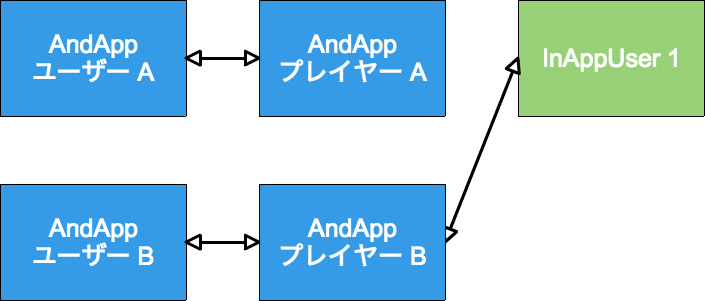
App User can be Interchangeable with AndApp Player Not Linking with Mobage
1.“AndApp user A”, “AndApp player A”, and “InAppUser 1” are linked with each other as shown below.
* “InAppUser 1” can be linked with “AndApp player A” in a new play or through the takeover or linkage function on the app side.

- When the AndApp client is uninstalled and installed on another PC, “AndApp user B” and “AndApp player B” are created. Also, these players can be linked with “InAppUser 1". However, the linkage between “AndApp player A” and “InAppUser 1” must be broken, and a single AndApp player must be linked with a single InAppUser.
App User cannot be Interchangeable with AndApp Player Linked with Mobage
1.“AndApp user A”, “AndApp player A”, and “InAppUser 1” which are linked with Mobage are connected with each other as shown below. * “InAppUser 1” can be linked with “AndApp player A” in a new play or through the takeover or linkage function on the app side.
①
- When the AndApp client is uninstalled and installed on another PC, “AndApp user B” and “AndApp player B” are created. However these players cannot be linked with “InAppUser 1", as “InAppUser 1” is linked with “AndApp player A”, who is already linked with Mobage and the linkage cannot be broken.
②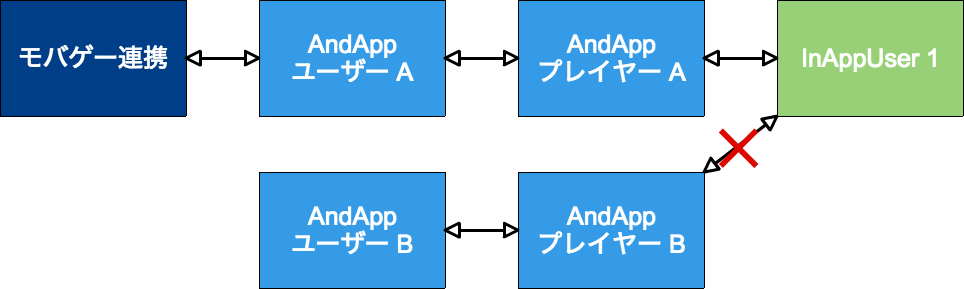
- Similarly, previous player authentication cannot be implemented, as the data takeover or linkage other than in the first startup is prohibited. In addition, linking with a new “InAppUser 2” again cannot be performed.
③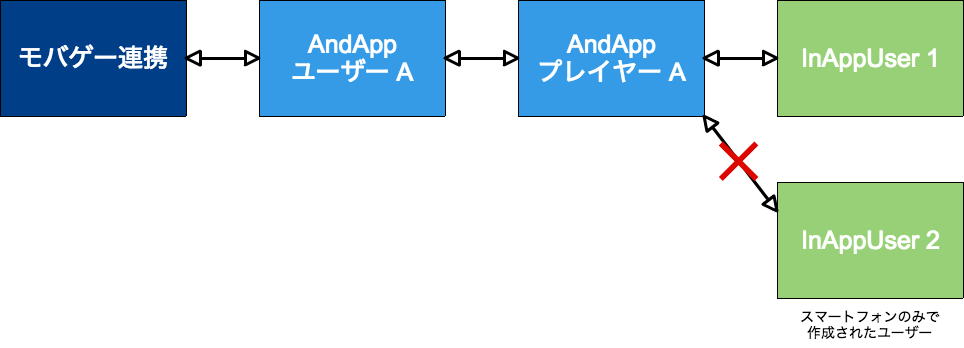
**About New Player Authentication (**Client API / RESTful API)
Some restrictions in the previous player authentication are eased in the new player authentication. Also, the data takeover or linkage other than in the first startup is enabled.
App User can be Interchangeable with AndApp Player Linked with Mobage
1.“AndApp user A”, “AndApp player A”, and “InAppUser 1”, which are linked with Mobage, are connected with each other as shown below.
* “InAppUser 1” can be linked with “AndApp player A” in a new play or through the takeover or linkage function on the app side.
①
- “InAppUser 2” with data of only the smartphone can be linked again with “AndApp player A”. However, the relationship between AndApp player A and “InAppUser 1” is broken, and a single AndApp player must be linked with a single InAppUser.
②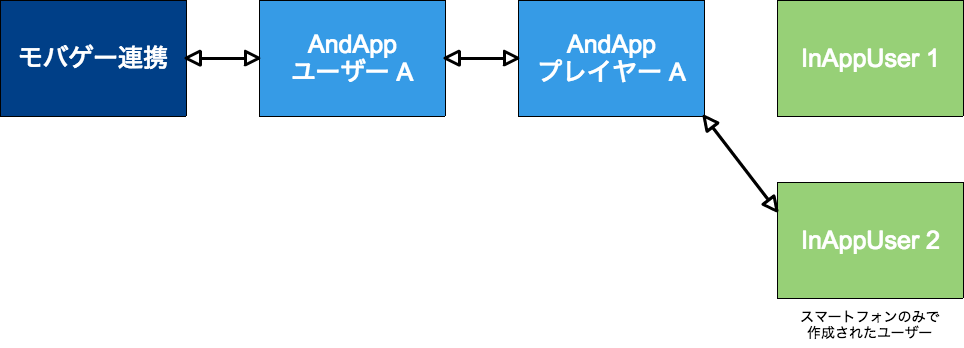
- However, “InAppUser 1”, whose linkage with “AndApp player A” is broken, cannot be linked again with “AndApp user B” or “AndApp player B”.
③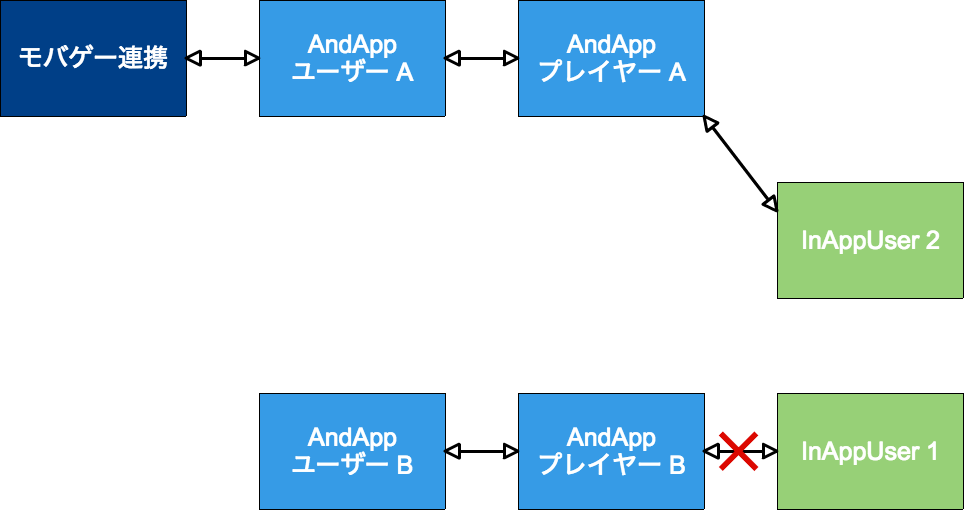
- Also, the relationship among “AndApp user A”, “AndApp player A”, and “InAppUser 1”, which are linked with Mobage, and the relationship among “AndApp user B”, “AndApp player B”, and “InAppUser 2”, which are not linked with Mobage, can be structured.
④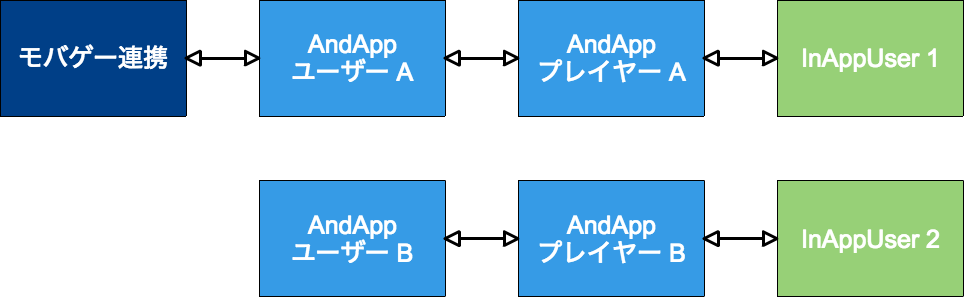
- In this case, “InAppUser 2” can be linked again with “AndApp player A”. However, the relationship between AndApp player A and “InAppUser 1” is broken, and a single AndApp player must be linked with a single InAppUser.
⑤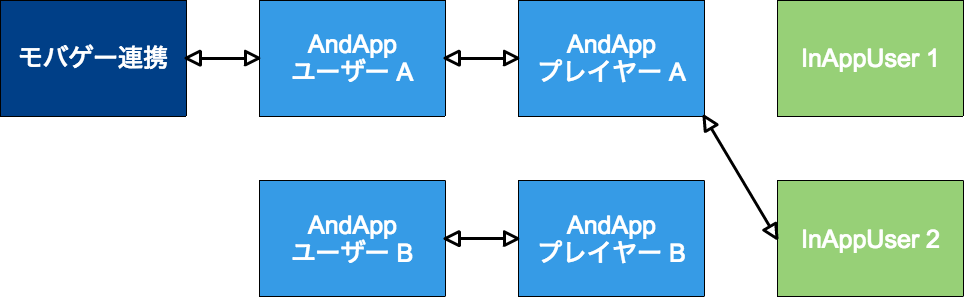
- Conversely, “InAppUser 1” linked with “AndApp player A” through the linkage with Mobage cannot be linked again with “AndApp player B”, as “InAppUser 1” is already linked with the player linked with Mobage.
⑥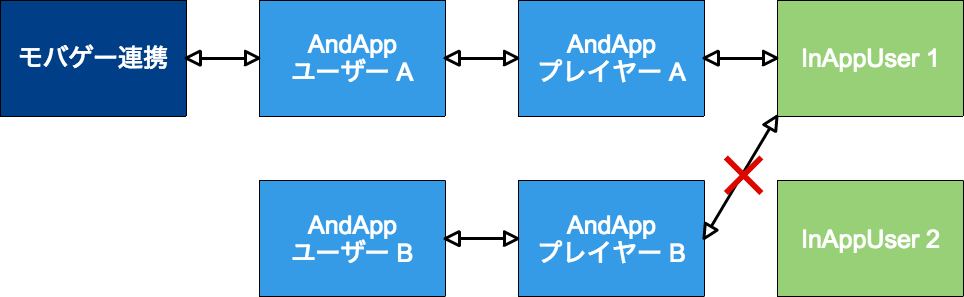
Advantages in New Player Authentication
- Data takeover or linkage other than in the first startup is enabled.
- An app user linked with the player through the linkage with Mobage can be linked again with another app user. As a result, the following cases can be improved.
- You started a new play by mistake at the AndApp client linked with Mobage.
- It can be solved by taking over data on the way (linking with different app users).
- Incorrect data is taken over at the AndApp client linked with Mobage.
- It can be solved by taking over data on the way (linking with different app users).
- You started a new play by mistake at the AndApp client linked with Mobage.
- If the player is ever linked with the app user through the linkage with Mobage, that app user cannot be linked with other players.
- However, the app user can be linked again with the player linked with Mobage who had been linked previously.
Update History
- March 15, 2017
- Newly created